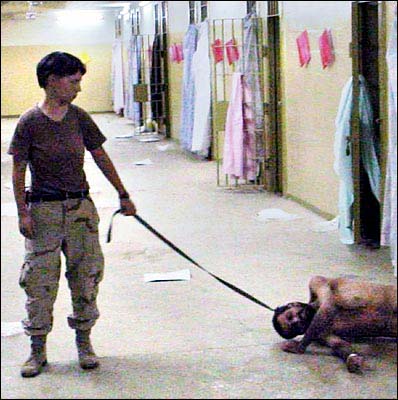
Showing posts with label torture. Show all posts

Sunday, April 11, 2010

Calder, Rendition


One of the most common arguments used to justify torture is that it may save lives by gaining information about future terrorist attacks. This information may help stop or prevent this hypothetical terrorist attack. But what happens when the suspect does not know anything or is innocent (as is the case in Rendition)? In the movie, Anwar, a completely innocent man, is tortured. After many scenes of torture he finally confesses that he helped build a bomb that was set off in a public square. He then gives the names of his “co-conspirators”. The CIA agent in charge of his captivity later questions his confession, after the names are found to be the members of an Egyptian soccer team. The CIA agent questions the legitimacy of torture by quoting The Merchant of Venice: “I fear you speak upon the rack. Where men enforced do speak anything.”

What justifies hooking a battery to a human being, and pressing the on switch every time he gives an answer you do not like? The Untied Nations and the Geneva conventions say that nothing justifies torture. Both give protection from cruel and unusual punishment to captured enemy combatants. I also believe that no nation has the right to torture under any circumstances. When a suspected, or even known, terrorist is disappeared to a secret prison, they have no way of knowing if this person has any actual information of a plot to kill. Even if the person did have credible information, the morality of the nation is compromised. If we torture what makes Guantanamo Bay any different from the Hanoi Hilton? How are our leaders that sanctioned torture any different from Saddam Hussein or Ferdinand Marcos?

Wednesday, April 7, 2010

Loos, Rendition


One interesting point that Rendition and the articles show is that there is usually very little evidence to show that the person is a terrorist. The "theory" behind torture is that if the suspect is a terrorist, he will admit it under torture. Jake Gyllenhaal's character points out the flaw in this logic when he quotes Shakespeare and basically says a man being tortured will say anything just to get the torture to stop. Now, let's say there is solid evidence that this man is a terrorist. Torture should still not be used as a method to extract information, because any information would be thrown out in a court of law. There is a very interesting Criminal Minds (a show on CBS about criminal psychologists with the FBI) episode in which the team goes to Guantanamo Bay to interview a terrorist who is thought to be invovled with an anticipated terrorist attack in 24 hours. The team conducts an interview without using torture and based on little hints the terrorist unintentionally drops, extensive back group research, and the team's reasoning skills, the terrorist attack is prevented. Obviously, this is a television show, but I feel that there are more effective and more humane ways to extract information from a terrorist in the most extreme circumstances. Gyllenhaal's character uses his reasoning skills to see that Anwar is innocent and has been making up information. I think the government could extract information more efficiently and humanely if it arrests actual terrorists, not innocent men with vague ties to terrorism (as is the case with Anwar), and if it uses not intelligent methods to extract information and not brute force.

Tuesday, March 23, 2010

Unforgivable


Torture is about inflicting pain or suffering intentionally on a person in either a mental or physical way. Torture is however, under international law, prohibited. No person has the right to resort to torture. Torture can be criticized on the grounds of humanitarian and morals. Obviously you are taking away the freedom of the victim during torture. The victim should not be put under pain to reveal information, nor should they suffer for a group of people. No matter who it is, or what they have done in their past every life holds value and meaning. I feel there are such greater heights that are morally acceptable that the government could resort to before they turn to torture. Nothing is positive about torture. Even if you get the results you want from taking away the pride and freedom from the victim the consequences following the procedures could be worse. There could be followers of the victim that could come back harder, or something along those lines. Torture is a subject, which is up for discussion for most people. Some say its understandable for personal reasons that touch close to home, like if someone killed your family member or something like that. I still find no need to turn to violence. Violence is a strong action that can never be taken back. 

Saturday, March 20, 2010

McCay Rendition Post

In the abstract, I am sure all of us would say that we are opposed to torture, and the film, Rendition, shows a very mild form of torture; however, do you believe there is a circumstance in which a person, an army, a government has the right to resort to torture? Give specifics of your example and your reasoning.